|
HVAC
(Heating, Ventilation and Air Conditioning)
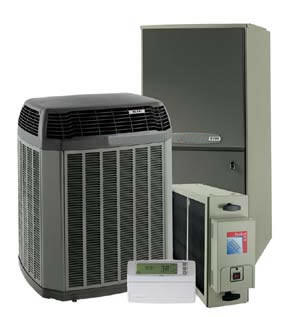
|
HVAC
(pronounced "H-V-A-C" is an
acronym that stands for "heating,
ventilation, and air conditioning".
HVAC is sometimes referred to as "climate control" and is
particularly important in the design of medium to large industrial
and office buildings such as sky scrapers and in marine environments
such as aquariums, where humidity and temperature must all be
closely regulated whilst maintaining safe and healthy conditions
within. In certain regions (e.g., UK) the term "Building Services"
is also used, but may also include plumbing and electrical systems.
Refrigeration is sometimes added to the field's abbreviation as
HVAC&R or HVACR, or ventilation is dropped as HACR
(such as the designation of HACR-rated circuit breakers).
Heating, ventilation, and
air conditioning is based on the basic
principles of thermodynamics, fluid mechanics,
and heat transfer, and to inventions and
discoveries made by
Michael Faraday,
Willis Carrier,
Reuben Trane,
James Joule,
William Rankine,
Sadi Carnot, and many
others. The invention of the components of HVAC
systems goes hand-in-hand with the industrial
revolution, and new methods of modernization,
higher efficiency, and system control are
constantly introduced by companies and inventors
all over the world.
The three functions of
heating, ventilation, and air-conditioning are
closely interrelated. All seek to provide
thermal comfort, acceptable indoor air quality,
and reasonable installation, operation, and
maintenance costs. HVAC systems can provide
ventilation, reduce air infiltration, and
maintain pressure relationships between spaces.
How air is delivered to, and removed from spaces
is known as room air distribution.
In modern buildings the
design, installation, and control systems of
these functions are integrated into one or more
HVAC systems. For very small buildings,
contractors normally "size" and select HVAC
systems and equipment. For larger buildings
where required by law, "building services"
designers and engineers, such as mechanical,
architectural, or building services engineers
analyze, design, and specify the HVAC systems,
and specialty mechanical contractors build and
commission them. In all buildings, building
permits for, and code-compliance inspections of
the installations are the norm.
The HVAC industry is a
worldwide enterprise, with career opportunities
including operation and maintenance, system
design and construction, equipment manufacturing
and sales, and in education and research. The
HVAC industry had been historically regulated by
the manufacturers of HVAC equipment, but
Regulating and Standards industries such as
ASHRAE,
SMACNA,
ACCA,
and
AMCA, have been
established to support the industry and
encourage high standards and achievement. Most
recently, the ICC has been established to create
international standards that many countries,
including the US, Canada, the UK, Australia and
many others have been adopting.
HVAC energy efficiency and noise
Heating energy
Water heating is more efficient for heating
buildings and was the standard many years ago.
Today forced air systems can double for air
conditioning and are more popular. The most
efficient central heating method is
geothermal heating.
Energy efficiency can be improved even more
in central heating systems by introducing zoned
heating. This allows a more granular application
of heat, similar to non-central heating systems.
Zones are controlled by multiple
thermostats. In water heating systems the
thermostats control
zone valves, and in forced air systems they
control
zone dampers inside the vents which
selectively block the flow of air.
Air conditioning energy
The performance of vapor compression
refrigeration cycles is limited by
thermodynamics. These AC and
heat pump devices move heat rather
than convert it from one form to another, so
thermal efficiencies do not
appropriately describe the performance of these
devices. The Coefficient-of-Performance
(COP) measures performance, but this
dimensionless measure has not been adopted, but
rather the Energy Efficiency Ratio (EER).
To more accurately describe the performance of
air conditioning equipment over a typical
cooling season a modified version of the EER is
used, and is the Seasonal Energy Efficiency
Ratio (SEER). The
SEER article describes it further, and
presents some economic comparisons using this
useful performance measure.
On
occasion, certain issues come up requiring some type
of backup documentation, below are the code
references for certain deficiencies discovered at an
inspection.
Permits
required
Martin County: (772) 214-9929 Broward/Palm Beach Counties: (954) 340-6615
Email me at:
ev@magnuminspections.com
(Back to Top)